Best Equatorial Mounts for Astrophotography
By DeepField · 11 min read · Updated September 2026
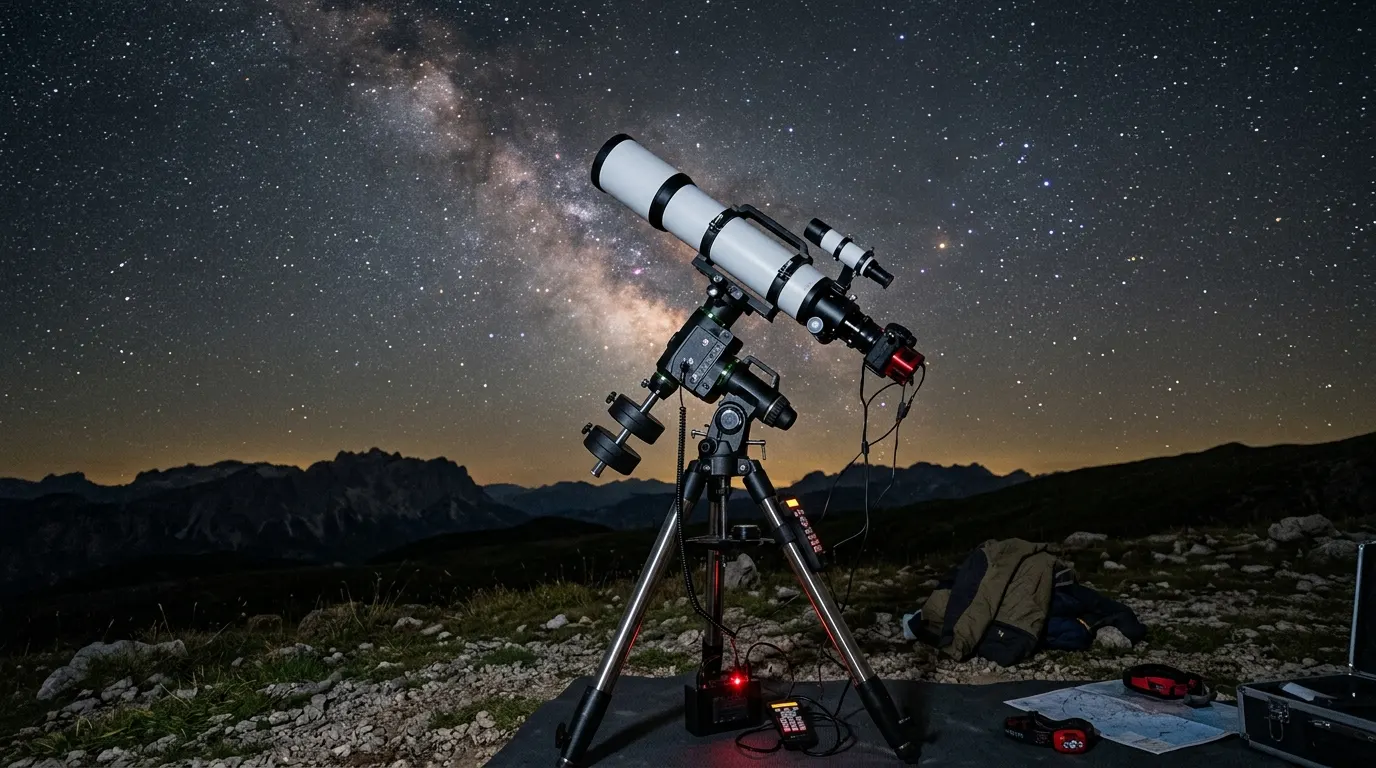
The mount is the foundation of every deep-sky imaging rig. Everything else depends on it: a good mount transforms a decent telescope into a capable imager; a poor mount ruins the best optics money can buy. The Sky-Watcher EQ6-R Pro GoTo Equatorial Mount is the community default for mid-sized rigs, pairing a 44 lb payload with belt-drive tracking and reliable SynScan GoTo. For travel or rooftop work where weight matters, the ZWO AM5N Harmonic Drive Equatorial Mount carries the same payload in a 12 lb package. For beginners on a tighter budget, the iOptron CEM26 Center-Balanced Equatorial Mount and Celestron Advanced VX GoTo Equatorial Mount both deliver solid mid-payload performance. For wide-field Milky Way work, the Sky-Watcher Star Adventurer 2i Pro Pack weighs under three pounds. This guide walks through the mounts that matter, ranked by the real-world outcomes they deliver.
Quick answer
The Sky-Watcher EQ6-R Pro is the best all-around equatorial mount for astrophotography, carrying 44 lbs of payload with low periodic error and native PHD2 and NINA compatibility at a price between budget and observatory-class gear. For travel or portability, the ZWO AM5N harmonic mount delivers equivalent payload in half the weight. For Milky Way tracking, the Sky-Watcher Star Adventurer 2i weighs under three pounds and fits in carry-on luggage.
This guide contains affiliate links. DeepField may earn a commission at no cost to you.
What makes a good equatorial mount for astrophotography?
An equatorial mount is a telescope support that aligns one axis (the RA, or right ascension axis) parallel to Earths rotation axis, so the mount can track the night sky with a single motor instead of two. This single-axis tracking is the foundation of deep-sky imaging because it allows multi-minute exposures without star trails. The quality of the mount determines three measurable outcomes: how heavy a load it can track (payload), how much the tracking drifts away from its target over minutes or hours (periodic error), and how accurately it points at a specific object in the sky (GoTo accuracy).
For guided deep-sky imaging with autoguiding software like PHD2, periodic error is the critical number. A mount with sub-20 arcsecond periodic error means autoguiding has an easy time correcting and the imaging session is productive. A mount with 50 to 100 arcsecond periodic error means the guide algorithm spends its time fighting the mounts natural drift instead of holding steady at the current position. Periodic error is sometimes published by the manufacturer, but the real test is autoguiding performance: if other users report clean RMS errors below 1.5 arcseconds with the mount, it has acceptable periodic error for your rig.
Payload matters, but overloading matters more. A mount rated at 40 lbs is mechanically capable of carrying 40 lbs, but that is the limit, not the recommendation. For reliable tracking and guided imaging, keep the total load (telescope plus camera plus guide scope plus accessories) to 50 to 60 percent of the mounts rated capacity. A 40 lb mount is happy at 20 to 24 lbs. Exceeding that margin strains the motors, increases periodic error, and makes autoguiding harder.
The gold standard: Sky-Watcher EQ6-R Pro
The Sky-Watcher EQ6-R Pro GoTo Equatorial Mount has become the most widely used mid-payload mount in the astrophotography community because it combines several hard-to-find qualities in a single package: a 44 lb payload, a belt-drive system that eliminates the backlash plaguing budget gear mounts, periodic error low enough that autoguiding settles quickly, and native SynScan GoTo that works seamlessly with PHD2, NINA, and the ZWO ASIAIR without any workarounds. At around $2,200 to $2,300, it sits above consumer-level budget mounts and well below observatory-class gear.
The belt-drive mechanism is worth the price alone. Gear-driven mounts accumulate backlash the motors must overcome every time the RA axis changes direction during periodic-error correction. Belt-drive mounts rotate smoothly with near-zero backlash, so the mount tracks predictably and the guide algorithm does not waste cycles fighting stick-slip behavior. The result is that most EQ6-R Pro users report RMS guiding errors below 1 arcsecond with a modest 60 to 80 second guide oscillation period.
Assembly and polar alignment are straightforward on the EQ6-R Pro, but the mount does require a good polar scope or a software polar-alignment routine to get the most from it. The included polar scope uses the standard Polaris star-centered reticle method, which is fast once you learn it. Alternatively, NINA, SharpCap, and the ZWO ASIAIR all include built-in software polar-alignment routines that use plate-solving on short drift exposures to guide you to accurate alignment without needing to see Polaris.

Sky-Watcher EQ6-R Pro GoTo Equatorial Mount
The community default for mid-payload deep-sky imaging: belt-driven, 44 lb capacity, SynScan GoTo, and rock-solid long-exposure tracking that works with PHD2 and NINA out of the box.
For travel and rooftop imaging: ZWO AM5N harmonic mount
The ZWO AM5N Harmonic Drive Equatorial Mount represents a new category for deep-sky imaging: a full GoTo mount with a 28 lb payload that weighs only 12 lbs and does not require a counterweight on most typical small-to-medium refractors. Harmonic-drive mounts use a wave-generator mechanism instead of a traditional worm gear or belt-drive system, which gives them exceptional compactness and zero-backlash tracking in a lightweight package.
For a travel rig built around a small 60 mm to 80 mm apochromatic refractor, a ZWO ASI camera, and a guide camera, the AM5N comfortably handles the total payload while fitting in airline check-in luggage when packed in a hard case. The entire imaging rig including the mount, tripod, telescope, guide scope, and accessories can weigh under 25 lbs, which compares favorably with a traditional German equatorial mount of equivalent payload. Sub-10 arcsecond periodic error means autoguiding is easier to tune and the session is productive from the first night.
The one caution with harmonic mounts is balance sensitivity. The wave-generator mechanism does not tolerate a heavily front-heavy optical tube as well as a traditional GEM with its counterweight system. Balance your telescope within a few inches of the mount center, and the AM5N performs beautifully. Front-heavy setups may show tracking degradation that counterweighting on a traditional GEM would solve effortlessly.

ZWO AM5N Harmonic Drive Equatorial Mount
A compact harmonic-drive GoTo mount that carries 28 lbs without a counterweight, weighs only 12 lbs, and delivers sub-10 arcsecond periodic error straight from the factory.
Budget mid-payload alternatives: iOptron CEM26 and Celestron Advanced VX
For astrophotographers stepping up from a tracker but not ready for a $2,200 purchase, the iOptron CEM26 Center-Balanced Equatorial Mount and Celestron Advanced VX GoTo Equatorial Mount both deliver solid mid-payload performance at prices around $900 to $1,250. Both are computer-controlled GoTo mounts with reasonable periodic error and enough payload for an 80 mm refractor or 8 inch SCT with a guide scope.
The iOptron CEM26 Center-Balanced Equatorial Mount uses a center-balanced design that lowers the overall center of gravity, giving it slightly more stable tracking than a traditional German equatorial mount at the same price. Its AccuAlign polar scope makes fast polar alignment straightforward, and the 26 lb payload covers most imaging setups well. The community tends to report slightly cleaner periodic error numbers on the CEM26 compared to the Celestron VX, which means autoguiding settles a bit faster.
The Celestron Advanced VX GoTo Equatorial Mount carries a 30 lb payload and uses the familiar NexStar+ hand controller that many users already know from Celestron telescopes. It has good community support and widespread aftermarket compatibility. The worm-gear design has more backlash than the belt-drive EQ6-R, so periodic error is higher; autoguiding helps significantly to clean up the tracking. For less, the CEM26 typically reports slightly better performance, but the Advanced VX remains a capable performer at this price point.

iOptron CEM26 Center-Balanced Equatorial Mount
A center-balanced EQ mount with 26 lbs capacity, AccuAlign polar scope, and a smart controller, designed with a low center-of-gravity that improves tracking stability over a standard GEM.

Celestron Advanced VX GoTo Equatorial Mount
A mid-payload computerized GEM with a 30 lb capacity and the Celestron NexStar+ hand controller, a reliable stepping stone into guided deep-sky imaging.
For wide-field Milky Way work: Star Adventurer 2i and SkyGuider Pro
Wide-field Milky Way photography and guided deep-sky imaging have completely different requirements. Wide-field work with a DSLR or mirrorless body and a 14 mm to 50 mm lens needs only a simple star tracker that provides accurate RA tracking so exposures do not trail. The Sky-Watcher Star Adventurer 2i Pro Pack weighs under three pounds for the drive head and mounts to any photo tripod with a ball head, fitting comfortably in carry-on luggage. It handles a DSLR with a 200 mm telephoto lens reliably and includes Wi-Fi control via the SynScan app.
The iOptron SkyGuider Pro Camera Mount is the direct competitor and differentiates itself with a built-in illuminated polar scope and a fine-adjustment declination bracket for precise framing correction without touching the tripod. For photographers who value having a built-in polar scope over the Star Adventurer Wi-Fi and prefer a slightly more rigid construction, the SkyGuider Pro is the alternative worth evaluating. Both carry an 11 lb payload and are designed for landscape astrophotography and travel.
Neither of these trackers is suitable for guided deep-sky imaging with guide cameras and long exposures because they lack GoTo capability and have limited payload. Use a tracker for Milky Way work and a full GEM for guided deep-sky work; the two have no overlap in practice.
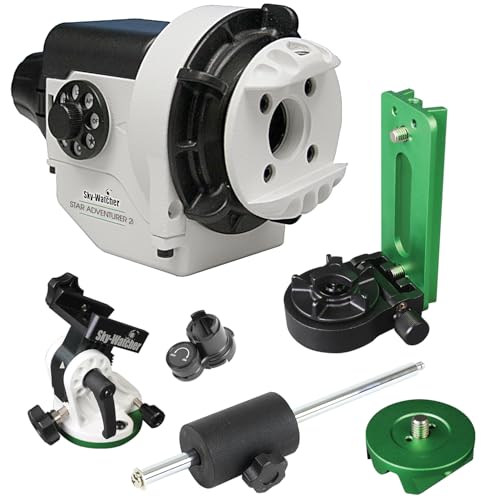
Sky-Watcher Star Adventurer 2i Pro Pack
An 11 lb payload star tracker that mounts to any photo tripod and provides accurate RA tracking for wide-field and telephoto astrophotography on the road.

iOptron SkyGuider Pro Camera Mount
An 11 lb payload tracker with a built-in polar illuminator, fine RA adjustment knob, and a declination bracket that allows precise framing corrections.
Matching a mount to your telescope and budget
A typical 80 mm apochromatic refractor weighs 5 to 8 lbs, a dedicated ZWO ASI deep-sky camera weighs under 1 lb, a guide scope weighs 0.5 lbs, and a guide camera weighs under 0.5 lbs, totaling 6 to 10 lbs. A mount rated for 44 lbs (like the EQ6-R Pro) is happy with this load and has room for growth. A mount rated for 26 to 30 lbs (like the iOptron CEM26) also carries it fine but leaves minimal margin for future upgrades like a larger telescope or a filter wheel.
If you plan to start with a modest 80 mm refractor and grow to a 120 mm later, the EQ6-R Pro makes sense despite its higher price because you will not outgrow it. If you are confident you will always use a small refractor and prioritize portability, the ZWO AM5N gets you 28 lbs of proven payload at half the weight. If budget is the constraint and you plan to stay with a small refractor long-term, the CEM26 or Advanced VX delivers good performance and frees up money for accessories.
For travelers and rooftop imagers, the star tracker mounts (Star Adventurer 2i or SkyGuider Pro) suit wide-field Milky Way work perfectly. For the same people wanting to do guided deep-sky imaging at dark sky sites, the ZWO AM5N is the only mount in its weight class that delivers acceptable periodic error for guiding.
Sky-Watcher EQ6-R Pro GoTo Equatorial Mount
The community default for mid-payload deep-sky imaging: belt-driven, 44 lb capacity, SynScan GoTo, and rock-solid long-exposure tracking that works with PHD2 and NINA out of the box.
ZWO AM5N Harmonic Drive Equatorial Mount
A compact harmonic-drive GoTo mount that carries 28 lbs without a counterweight, weighs only 12 lbs, and delivers sub-10 arcsecond periodic error straight from the factory.
iOptron CEM26 Center-Balanced Equatorial Mount
A center-balanced EQ mount with 26 lbs capacity, AccuAlign polar scope, and a smart controller, designed with a low center-of-gravity that improves tracking stability over a standard GEM.
Key setup steps that matter more than the mount itself
Once you have chosen a mount, three setup steps determine whether it performs well or poorly: polar alignment, balance, and periodic-error baseline. Polar alignment sets the foundation; even the best mount drifts hopelessly if the RA axis does not point at the celestial pole. Use software alignment routines in NINA or ASIAIR if available; they take the guesswork out of this critical step.
Balance affects both periodic error and motor strain. A front-heavy optical tube makes the mount work harder to hold position and increases the small errors that autoguiding must correct. Before a session, balance the telescope so it stays in position when you release it from the mount head. For traditional GEM mounts, adjust the counterweight; for harmonic mounts, move the telescope on its dovetail until balanced.
Once polar-aligned and balanced, connect to PHD2 or your imaging controller and run the Guiding Assistant if available. It measures your mounts actual periodic error profile on that night and recommends autoguiding tuning parameters. These parameters are the difference between settled guiding and a guide algorithm that spends all night fighting jitter and drift.
Featured in this guide
Sky-Watcher EQ6-R Pro GoTo Equatorial Mount
The community default for mid-payload deep-sky imaging: belt-driven, 44 lb capacity, SynScan GoTo, and rock-solid long-exposure tracking that works with PHD2 and NINA out of the box.
ZWO AM5N Harmonic Drive Equatorial Mount
A compact harmonic-drive GoTo mount that carries 28 lbs without a counterweight, weighs only 12 lbs, and delivers sub-10 arcsecond periodic error straight from the factory.
iOptron CEM26 Center-Balanced Equatorial Mount
A center-balanced EQ mount with 26 lbs capacity, AccuAlign polar scope, and a smart controller, designed with a low center-of-gravity that improves tracking stability over a standard GEM.
Celestron Advanced VX GoTo Equatorial Mount
A mid-payload computerized GEM with a 30 lb capacity and the Celestron NexStar+ hand controller, a reliable stepping stone into guided deep-sky imaging.
Sky-Watcher Star Adventurer 2i Pro Pack
An 11 lb payload star tracker that mounts to any photo tripod and provides accurate RA tracking for wide-field and telephoto astrophotography on the road.
iOptron SkyGuider Pro Camera Mount
An 11 lb payload tracker with a built-in polar illuminator, fine RA adjustment knob, and a declination bracket that allows precise framing corrections.
Keep reading
Related comparisons
Related roundups
FAQ
Frequently asked questions
What is the difference between a GoTo mount and a manual equatorial mount?+
A manual mount requires you to aim at the target manually and then turn on tracking, which tracks the target across the sky as it moves. A GoTo mount has motors that can automatically point at any object in a database and track it. For astrophotography, GoTo matters mainly for speed and convenience; accurate tracking and low periodic error matter far more for image quality.
Do I need autoguiding with a modern belt-drive mount?+
For exposures under two minutes and focal lengths under 500 mm, a well-polar-aligned belt-drive mount can sometimes work without guiding. Beyond that, autoguiding corrects the small periodic errors that accumulate over longer subs, allowing four to ten minute exposures. For focal lengths above 800 mm or any narrowband work requiring multi-minute exposures, autoguiding is strongly recommended.
How much payload do I really need?+
Keep your imaging load at roughly 50 to 60 percent of the mounts rated capacity. Manufacturers rate at the mechanical limit, not the imaging sweet spot. A mount listed at 40 lbs is happy at 20 to 24 lbs of telescope, camera, guide scope, and accessories. Overloading strains the motors and worsens periodic error.
What is a harmonic or strain-wave drive mount?+
Harmonic drives replace a traditional gear train with a wave-generator mechanism that has near-zero backlash and requires no counterweight on lighter setups. They are exceptionally compact and light for their payload, making them ideal for travel. The trade-off is they are more sensitive to balance than a traditional GEM.
Can I polar-align without a polar scope?+
Yes. Software polar-alignment routines in NINA, SharpCap, or the ZWO ASIAIR use plate-solving on short drift exposures to guide you to accurate polar alignment without a polar scope. Many imagers prefer this because it works with any camera already attached to the mount.
What is periodic error and why does it matter?+
Periodic error is the regular, cyclic drift a mount produces as it tracks the sky. A mount with 20 arcsecond periodic error drifts a small, predictable amount each minute, which autoguiding corrects easily. A mount with 100 arcsecond periodic error drifts much more, making the autoguiding algorithm work harder and taking longer to settle.