DeepField

Best Equatorial Mounts for Astrophotography

An equatorial mount is the foundation of any deep-sky imaging rig. It tracks the rotation of the sky on a polar-aligned axis so your exposures do not trail. We cover portable star trackers for travel through heavy-payload German equatorial mounts for full observatory setups, grading each on payload capacity, periodic error, polar-alignment ease, and how well they integrate with modern guiding software like PHD2 and NINA.

Quick answer

The Sky-Watcher EQ6-R Pro is the best equatorial mount for most astrophotographers, pairing a 44 lb payload, belt-drive backlash reduction, and reliable SynScan GoTo with a price that sits between portable trackers and observatory-class gear. For travel, the ZWO AM5N harmonic mount carries 28 lbs without a counterweight in a compact, lightweight package.

DeepField may earn a commission from links below, at no cost to you. Last updated June 2026.

Top Pick Sky-Watcher EQ6-R Pro GoTo Equatorial Mount
4.7 Amazon

Sky-Watcher EQ6-R Pro GoTo Equatorial Mount

The community default for mid-payload deep-sky imaging: belt-driven, 44 lb capacity, SynScan GoTo, and rock-solid long-exposure tracking that works with PHD2 and NINA out of the box.

Best for Astrophotographers who want the proven mid-payload workhorse that the deep-sky community trusts most.

Belt-drive system eliminates gear backlash for clean star trails44 lb payload handles a full imaging rig with guide scope and cameraNative SynScan protocol works seamlessly with PHD2, NINA, and ASIAIR Requires a decent polar scope or software polar alignment routine to get the best results
No. 2 ZWO AM5N Harmonic Drive Equatorial Mount
4.6 Amazon

ZWO AM5N Harmonic Drive Equatorial Mount

A compact harmonic-drive GoTo mount that carries 28 lbs without a counterweight, weighs only 12 lbs, and delivers sub-10 arcsecond periodic error straight from the factory.

Best for Imagers who travel frequently or image from a rooftop and need a high-performance mount without the weight of a traditional GEM.

28 lb payload without a counterweight needed on most rigs, making it exceptionally portableSub-10 arcsecond periodic error means autoguiding is easier to tuneNative ASIAIR integration and Bluetooth control Sensitive to balance; the harmonic mechanism does not tolerate a heavily front-heavy OTA as well as a geared mount
No. 3 iOptron CEM26 Center-Balanced Equatorial Mount
4.5 Amazon

iOptron CEM26 Center-Balanced Equatorial Mount

A center-balanced EQ mount with 26 lbs capacity, AccuAlign polar scope, and a smart controller, designed with a low center-of-gravity that improves tracking stability over a standard GEM.

Best for Imagers who want a stable, lighter-weight GEM alternative with a practical polar scope at a step below EQ6-R pricing.

Center-balanced design lowers the overall center of gravity for more stable trackingAccuAlign polar scope makes fast, accurate polar alignment straightforwardSolid 26 lb payload with a mount head weight under 10 lbs Center-balance design requires specific counterweight placement versus a standard GEM
No. 4 Sky-Watcher Star Adventurer 2i Pro Pack
4.5 Amazon

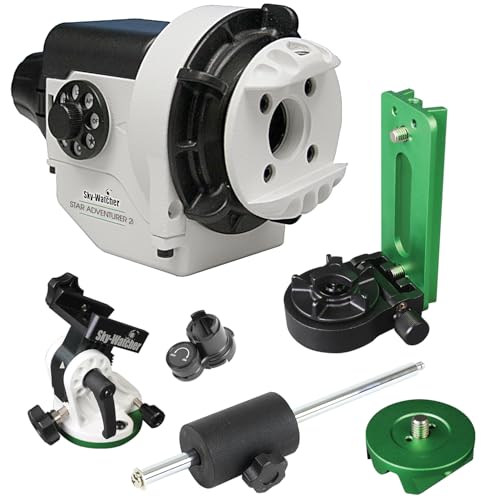
Sky-Watcher Star Adventurer 2i Pro Pack

An 11 lb payload star tracker that mounts to any photo tripod and provides accurate RA tracking for wide-field and telephoto astrophotography on the road.

Best for Landscape astrophotographers and travelers who want accurate tracking for wide to medium telephoto shots without carrying a full GEM.

Under 3 lbs for the drive head, fits in carry-on luggageWi-Fi control via the SynScan appHandles a DSLR with a 200 mm telephoto lens reliably 11 lb payload limit means no room for heavy refractors or guide scope add-ons
No. 5 iOptron SkyGuider Pro Camera Mount
4.4 Amazon

iOptron SkyGuider Pro Camera Mount

An 11 lb payload tracker with a built-in polar illuminator, fine RA adjustment knob, and a declination bracket that allows precise framing corrections.

Best for Photographers who prioritize a built-in polar scope and fine declination adjustment over the Star Adventurer Wi-Fi.

Built-in illuminated polar scope for fast polar alignment at nightFine-tuning declination bracket enables precise framing in the fieldCompact and sturdy metal construction No built-in battery; requires external AA pack or USB power bank
No. 6 Celestron Advanced VX GoTo Equatorial Mount
4.3 Amazon

Celestron Advanced VX GoTo Equatorial Mount

A mid-payload computerized GEM with a 30 lb capacity and the Celestron NexStar+ hand controller, a reliable stepping stone into guided deep-sky imaging.

Best for Beginners stepping up from a tracker who want a GoTo mount with Celestron ecosystem compatibility for under $900.

30 lb payload covers a typical 80 mm refractor or 8 inch SCT imaging rigNexStar+ hand controller works with CPWI software for PC controlWidespread community support and aftermarket polar alignment tools Worm gear design has more backlash than belt-drive mounts at this price point

The method

How we chose

We evaluated each option on fit, build quality, daily usability, and value. Our top pick, Sky-Watcher EQ6-R Pro GoTo Equatorial Mount, earned the spot because the most recommended mount in its payload class. if you want a single answer for a mid-sized imaging rig, this is it. The comparison above highlights exactly who each pick is best for.

FAQ

Best Equatorial Mounts for Astrophotography: FAQ

How much payload do I really need in an equatorial mount?+

Keep your imaging load at roughly 50 to 60 percent of the mount's rated capacity for reliable, guided tracking. Manufacturers rate at the mechanical limit, not the imaging sweet spot. A mount listed at 40 lbs is happy at 20 to 24 lbs of telescope, camera, guide scope, and accessories. Going heavier strains the motors and worsens periodic error.

What is the difference between a GoTo mount and a basic EQ mount?+

A GoTo mount has motorized right-ascension and declination axes driven by a hand controller or computer that can automatically point at and track any object in its database. A basic EQ mount tracks only on the RA axis with no pointing database. For astrophotography, GoTo matters mainly for setup speed; accurate tracking and low periodic error matter far more for image quality.

Do I need autoguiding with a modern belt-drive mount?+

For exposures under two minutes and focal lengths under 500 mm, a well-polar-aligned belt-drive mount can often get by without guiding. Beyond that, autoguiding corrects the small periodic errors that accumulate over longer subs, and it is strongly recommended for focal lengths above 800 mm or any narrowband work requiring exposures of three to ten minutes.

What is a harmonic or strain-wave drive mount and why is it popular?+

Harmonic drive mounts replace the traditional gear train with a wave-generator mechanism that has near-zero backlash and no counterweight requirement on lighter setups. They are exceptionally compact and light for their payload rating, which makes them ideal for travel or rooftop imaging. The trade-off is they are more sensitive to balance and firmware tuning than a traditional German equatorial mount.

Can I polar-align without a polar scope?+

Yes. Software polar-alignment routines in NINA, SharpCap, or the ZWO ASIAIR use plate-solving on short drift exposures to guide you to an accurate polar alignment without a polar scope. Many imagers prefer this because it works with any camera already attached to the mount. A polar scope is faster once you learn it but requires good illumination of the reticle and a clear view of Polaris.