Autoguiding Setup: Guide Scope, Camera, and PHD2
By DeepField · 11 min read · Updated June 2026
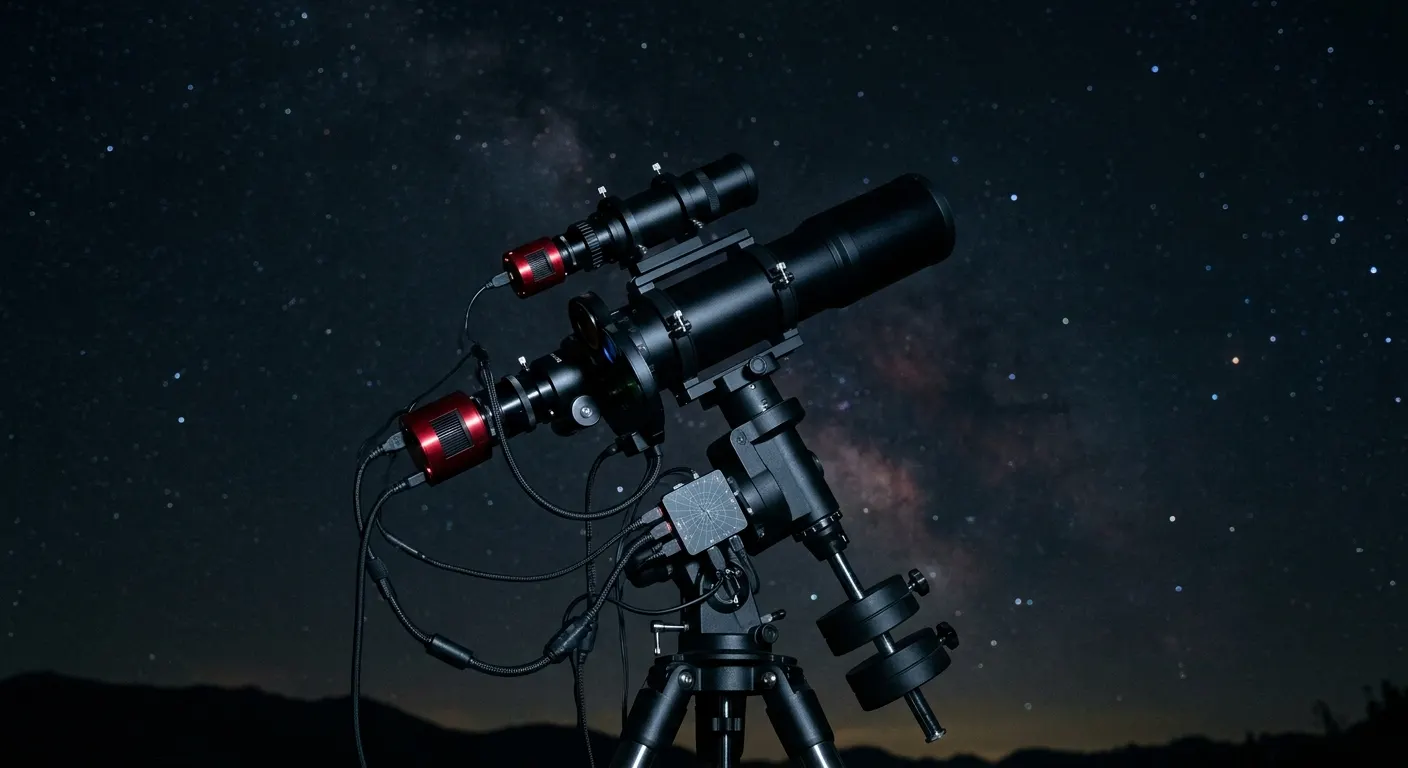
Autoguiding is the single biggest quality jump you can make after acquiring a decent mount. Without it, even a well-polar-aligned belt-drive mount drifts enough over three to five minutes that stars trail. With it, you can stack four to ten minute subs and pull genuinely faint signal out of a dark nebula. The hardware side of autoguiding is simple: a small guide scope, a sensitive guide camera, and PHD2 software running on your laptop or ASIAIR. The ZWO ASI220MM Mini Guide Camera is the current community standard for the camera, and either the ZWO 30mm f/4 Mini Guide Scope or the SVBONY SV165 60mm Guide Scope with Helical Focuser pairs well with it at every price point. Here is how to set it all up and tune it.
Quick answer
The most popular autoguiding setup in 2025 is a ZWO ASI220MM Mini guide camera paired with a 30 mm or 60 mm guide scope and PHD2. Connect the camera via USB, enter its focal length and pixel scale in the PHD2 profile, then run the Guiding Assistant for five to ten minutes. Aim for RMS guiding error below 1 arcsecond.
This guide contains affiliate links. DeepField may earn a commission at no cost to you.
Guide scope or off-axis guider: which is right for your setup?
A guide scope is a small separate telescope mounted in parallel with your imaging scope. It is easy to set up and gives a wide field with many guide stars to choose from. An off-axis guider inserts a pick-off prism into the main optical path and redirects a small fraction of the light to a guide camera, so both cameras always see the same optical axis.
For focal lengths under 1000 mm, a guide scope is almost always the better choice for beginners. The differential flexure between the guide scope and the imaging scope is small enough at these focal lengths that it does not cause meaningful one-directional star trails. The ZWO 30mm f/4 Mini Guide Scope weighs under 200 grams and adds almost nothing to the dovetail payload.
At focal lengths above 1000 mm, the small amount of play between the guide scope and the imaging tube is magnified enough by the longer focal length that it shows up as consistent elongation in one direction. That is the sign you need a ZWO OAG-L Off-Axis Guider. The OAG adds some back-focus distance to the imaging train, so check your camera backfocus budget before ordering.
For aperture between the 30 mm mini scope and a full OAG, the SVBONY SV165 60mm Guide Scope with Helical Focuser gives you 60 mm aperture and a helical focuser. The larger aperture significantly increases the number of available guide stars in sparse fields, and the helical focuser makes achieving focus much easier than the fixed-focus design of the 30 mm mini scope.

ZWO 30mm f/4 Mini Guide Scope
A compact 30 mm f/4 guide scope weighing under 200 grams that pairs directly with ZWO guide cameras and mounts with a standard dovetail foot.

SVBONY SV165 60mm Guide Scope with Helical Focuser
An affordable 60 mm aperture guide scope with a helical focuser and mounting rings, delivering more guide star options than a 30 mm mini scope at a very low price.
ZWO OAG-L Off-Axis Guider
An off-axis guider that inserts between the imaging telescope and camera to pick off a guide star from the main optical path, eliminating differential flexure at long focal lengths.
Choosing a guide camera: ASI220MM Mini versus ASI120MM Mini
The guide camera does not need to capture beautiful images. It needs to find a guide star reliably, measure its position precisely, and send correction signals to the mount fast enough to make a difference. Monochrome sensors perform better than color sensors for this because monochrome cameras have higher quantum efficiency at the wavelengths guide stars emit.
The ZWO ASI220MM Mini Guide Camera with its Sony IMX220 sensor is the current recommendation. It replaced the ZWO ASI120MM Mini Monochrome Guide Camera as the default because the newer sensor is meaningfully more sensitive, finding guide stars in thin clouds or sparse fields where the older ASI120MM struggles. Both cameras use a compact 30 mm body that fits directly onto any guide scope or OAG without adapters.
At current pricing the ZWO ASI120MM Mini Monochrome Guide Camera costs about the same as the ASI220MM Mini, so the budget case for it has mostly disappeared. It remains a proven and reliable guide camera used in thousands of setups worldwide if you already own one or find a discounted unit. It will guide successfully in most conditions; you just give up some margin in difficult conditions or sparse star fields.

ZWO ASI220MM Mini Guide Camera
A sensitive monochrome guide camera with a Sony IMX220 sensor and native USB-C, designed as the primary guide camera in the ZWO ASIAIR and PHD2 ecosystems.
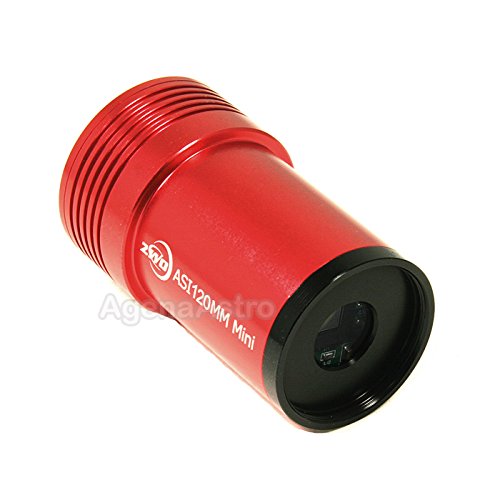
ZWO ASI120MM Mini Monochrome Guide Camera
The long-established guide camera standard, a monochrome sensor in a tiny 30 mm body, still a reliable way into autoguiding.
Connecting and configuring PHD2
PHD2 (Push Here Dummy 2) is the standard free autoguiding software. Download it from openphdguiding.org and install the drivers for your guide camera and mount before opening the program. PHD2 uses an equipment profile to store all settings for your specific combination of guide scope, camera, and mount.
In the Profile Manager, set the guide scope focal length, camera pixel size, and mount connection type. Setting the correct focal length and pixel size is critical because PHD2 uses these values to calculate the arcsecond-per-pixel scale, which determines how far to move the mount per correction step. Getting these wrong leads to over-correction or under-correction that no amount of tuning will fix.
For ASIAIR users, PHD2 runs embedded inside the ASIAIR device itself and the guide camera and mount connect via the ASIAIR's USB ports. The ASIAIR app handles profile setup with a guided wizard, which removes the manual PHD2 configuration for new users.

ZWO ASIAIR Plus 256GB Wi-Fi Imaging Controller
An all-in-one Raspberry Pi-based imaging controller that connects ZWO cameras, a GoTo mount, EAF autofocuser, and guide camera through a single device controlled from a phone app, eliminating the laptop entirely.
Running the Guiding Assistant
Once PHD2 is connected and guiding on a star, run the built-in Guiding Assistant from the Tools menu. Let it run for five to ten minutes while the mount tracks normally. The assistant measures your mount's periodic error profile and calculates recommended aggressiveness, hysteresis, and minimum move values specific to your mount's behavior on that night.
The most important output is the recommended total RMS guiding error baseline. For most setups, keeping total RMS below 1.5 arcseconds produces round stars at focal lengths up to 1000 mm. Below 1 arcsecond is excellent. The assistant will also tell you whether your polar alignment is good enough; if it recommends you re-polar-align before continuing, do that before trusting any other settings.
Avoid manually adjusting aggressiveness and hysteresis before running the Guiding Assistant at least twice. The assistant baseline is the foundation all other tuning builds on, and random tweaks without that baseline usually make guiding worse rather than better.
Dew on the guide scope is a silent autoguiding killer
Guide stars that suddenly bloat or disappear mid-session are often caused by dew on the guide scope objective, not a tracking problem. A dew heater strip wrapped around the guide scope's lens cell and connected to a dew controller keeps the glass a few degrees above the dew point. This is often overlooked because the guide scope is small and seems unimportant, but a dewed guide scope ruins autoguiding completely within minutes.
The Pegasus Astro DewZap Dual-Channel Dew Controller is an affordable two-channel PWM controller that runs both the main scope heater and the guide scope heater from one device. Run both channels from the start of the session, before dew forms, not after you have already lost a guide star.

Dew-Not Dew Heater Strips (Various Sizes)
An affordable dew heater strip range with velcro attachment and a standard RCA phono connector, compatible with all major dew controllers and sized for objectives from 1.25 inches to 12 inches.
Pegasus Astro DewZap Dual-Channel Dew Controller
A compact two-channel PWM dew controller from Pegasus Astro with per-channel adjustment knobs and the same build quality as the DewMaster at a lower price.
Featured in this guide
ZWO ASI220MM Mini Guide Camera
A sensitive monochrome guide camera with a Sony IMX220 sensor and native USB-C, designed as the primary guide camera in the ZWO ASIAIR and PHD2 ecosystems.
ZWO 30mm f/4 Mini Guide Scope
A compact 30 mm f/4 guide scope weighing under 200 grams that pairs directly with ZWO guide cameras and mounts with a standard dovetail foot.
SVBONY SV165 60mm Guide Scope with Helical Focuser
An affordable 60 mm aperture guide scope with a helical focuser and mounting rings, delivering more guide star options than a 30 mm mini scope at a very low price.
ZWO OAG-L Off-Axis Guider
An off-axis guider that inserts between the imaging telescope and camera to pick off a guide star from the main optical path, eliminating differential flexure at long focal lengths.
ZWO ASI120MM Mini Monochrome Guide Camera
The long-established guide camera standard, a monochrome sensor in a tiny 30 mm body, still a reliable way into autoguiding.
Keep reading
Related roundups
FAQ
Frequently asked questions
How do I know what PHD2 settings to use for my mount?+
Run the Guiding Assistant from the Tools menu in PHD2 for five to ten minutes while the mount tracks normally. It calculates recommended aggressiveness, hysteresis, and minimum move values based on your specific mount's measured periodic error profile. This baseline is far more reliable than manually picking numbers from a forum. Avoid adjusting values before you have the Guiding Assistant baseline.
Why do my guide stars keep disappearing mid-session?+
Disappearing guide stars mid-session are most commonly caused by dew on the guide scope objective, passing thin cloud, or a guide star that drifted out of the guide camera field due to a pointing error. Check whether the guide scope lens looks foggy or damp. Adding a dew heater strip on the guide scope objective prevents the dew cause entirely. If the sky is clear and the lens is dry, check that your guide scope is firmly clamped and has not rotated during the session.
Should I use a 30 mm or 60 mm guide scope?+
A 30 mm guide scope like the ZWO mini scope works well for focal lengths under 800 mm and in Milky Way fields where guide stars are plentiful. A 60 mm scope like the SVBONY SV165 gives you significantly more guide stars in sparse fields, which matters at higher declinations or in dark regions between spiral arms. If you regularly image with a longer focal length or in sparse star fields, the 60 mm aperture is worth the extra weight.
Can I guide with a color camera instead of a monochrome one?+
Yes, but monochrome cameras are more sensitive for guiding because they have higher quantum efficiency per pixel without the color filter array that blocks a portion of incoming light. A dedicated monochrome guide camera like the ZWO ASI220MM Mini finds guide stars more reliably in difficult conditions than a color sensor of the same pixel size. If you already own a color guide camera, it will guide successfully in most conditions.